The Fettuccia: Examining Our Role in the Kingdom of God

By Jennifer Miller, Elementary Catechist

Restaurant Blog Graphic (14).png

For the last two weeks in the Atrium, the Lower Elementary children have been contemplating the History of the Kingdom of God with a presentation commonly known as “The Fettuccia,” or “long, thin ribbon.” The main material of this work is a long ribbon, almost 100 yards, with moments of time marked in 4 different colors. If your child comes home asking for fettuccine or speaking a phrase that sounds Italian, this is why. The Fettuccia is a touchstone presentation in the Level II Atrium that is loved by all ages of the children. 

We return to the Fettuccia every year, and it parallels one of the “Great Lessons” that Maria Montessori shared for the Elementary, “The Story of God Who Has No Hands” which also is repeated every year. The presentation gives an impression on the History of the Kingdom of God, placing it through time.

The first meeting with the children is sharing with them the story of Creation: In the beginning, there was nothing but God, and then slowly, carefully, deliberately and so beautifully he created everything. The last to be created was man and woman, all of creation was entrusted to them. They were different from all the other beings because they were made in the image and likeness of God. They can love others, think and use their hands. Then comes Redemption, when Jesus was born, died and rose from the dead for us all. After Jesus came, His light and love is to spread for all of mankind. Finally we talk about the time that has still not unfolded; we help work together to build the Kingdom of God to prepare for Parousia (also known as the Second Coming or the End of Time), when Christ will return and “God will be all in all.”

unnamed (8).jpg

The second meeting of this presentation is with the materials, and there has been a buzz of expectation. The ribbon is longer than the length of the school building, so we bring the children outside for the unwinding of the ribbon. The children see and feel the ribs of the grosgrain ribbon. We don’t know how long it look for God to create the earth—no one was there but Him, so these ribs can symbolize 1 year, 100 years, or even 1000 years. The reel unfolds first a blue ribbon which marks creation before living things, then the ribbon changes to tan which marks the creation of plants and animals. The tan keeps unfolding, and towards the end there is an embroidered man and woman and a heart and hand. “Adam and Eve!” “Humans!” the children shout. Then there is a red cross symbolizing Jesus and another change of color to yellow, but it is a very short piece of ribbon. This is the time of Redemption. “Where are we on this ribbon?” The children take an arrow that has 2020 and point it to the very last rib of the yellow ribbon. But there are two more yards of white ribbon, ending in a brightly colored fringe of red and yellow. That white is the “Blank Page,” the future, the pages yet to be written. This is “our work” in building the Kingdom of God, to bring us to Parousia, the fringe on the end.  

This reasoning and abstracting child is now contemplating the unity and vastness of history, and seeing the Golden Thread, a thread that ties us as people and creation together with God as the source.

 

What a Wooden Table Brings to the Table: The Benefits of Natural Materials in the Classroom

Restaurant Blog Graphic (12).png

“The senses, being explorers of the world, open the way to knowledge.” -Dr. Maria Montessori

Upon entering an authentic Montessori environment, one of the first things you will notice is the materials. It is unlikely that you will encounter any cartoonish alphabet posters, any star charts, any brightly colored plastic cubbies or any plastic tables. What you will find is a variety of wooden, glass, and metal materials, sturdy child-sized furniture, house plants, and walls decorated with prints of classical artwork from cultures around the world. Maria Montessori insisted that an environment as closely rooted in nature and reality as possible was the most beneficial to the individual child. Here are some of the reasons why!

1. Naturally Sourced Materials Promote Sensorial Exploration

IMG_3738.jpg

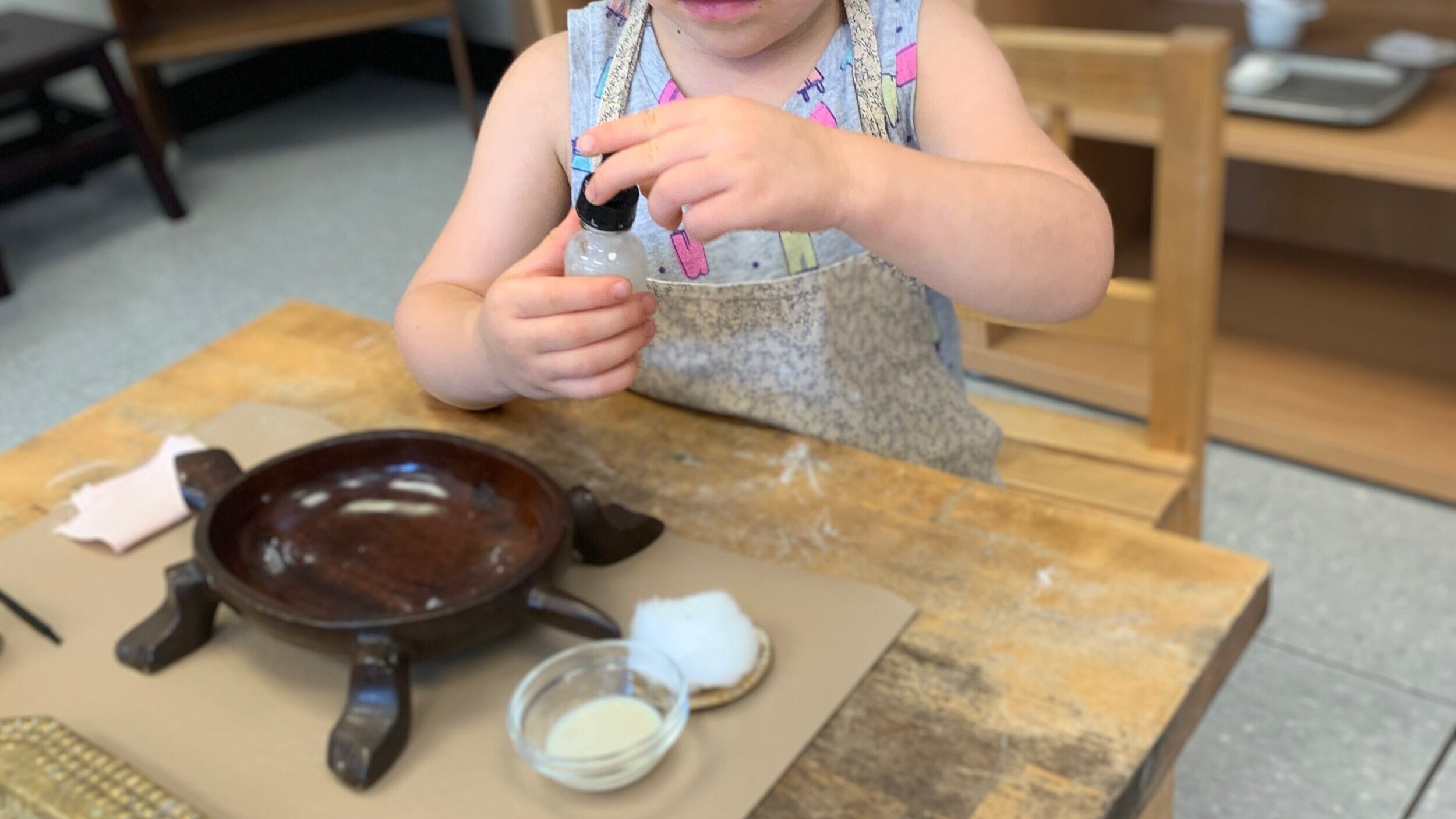
Dr. Montessori emphasized the use of real materials in the classroom. Materials such as brass, wood, wicker, cotton, metal, and glass provide important information to the child. Some warm to the touch and cool with the air. Others are rough and dense. Some are heavy and some are light. Some are durable and some are fragile. These provide a multi-sensorial experience for the child.

2. The Natural World Is Important for Development

By utilizing materials that come from nature in your child’s belongings, it puts them closer in touch to the real world around them. By doing this, you are encouraging a connection to the earth and the environment. 

3. Natural Materials Last

Plastics fade in color, and their quality is not normally the best. Natural toys made from wood or metal pass the test of time. They are durable, classic, and enduring. Many materials go years in the classroom before needing to be replaced. The child can work with the material with no fear of damage. 

4. Natural is Better for the Environment

Taking care of the environment is at the core of Montessori philosophy. It’s a positive that our materials don’t sit in landfills for years on end. Instead they can be recycled, re-purposed, or they will biodegrade. 

5. Natural Materials Are Beautiful

IMG_3783.JPG

The prepared environment is an important concept of Montessori learning. Natural materials are beautiful and real, thus making them more attractive and appealing to the child. 

6. They Inspire

Simple and natural materials create opportunities for open-ended work. This allows children to make their own discoveries, test hypotheses, and develop new skills, particularly when the child plays independently.

Overall, what parents want for their children is for them to feel comfortable, safe and happy, whether they are at home or at school. A Montessori environment is meant to mimic and be an extension of the home. Every detail is designed to ensure that it is a place where the child can feel truly at home and at ease. Our children deserve the best that we can give them, and the best that we can give them is reality and beauty.

Math and the Toddler Child

By Claire Nguyen, Toddler Directress

Restaurant Blog Graphic (10).png

Some parents might be wondering, “what does Math look like in a Montessori Infant-Toddler community?” Like other concepts, it is presented in developmentally appropriate ways, although they may not always look "math-y." For example, we know that young children learn through movement and exploration in these communities. It's critical, then, that the physical environment provide realistic, predictable feedback as young children move through it, reinforcing their spatial awareness. Objects with which the children interact need to respond the same way to each interaction, reinforcing the lessons that children learn as they explore. If you notice, Montessori Infant-Toddler classrooms do not have (or rarely have) battery-driven toys available. Because we want children to build their capacity for prediction and their ability to sort and classify real information. There aren't responses (like noises or movements) that aren't driven by the child's own actions. By interacting in a predictable environment and building their understanding of cause and effect, children's mathematical minds develop. You won't see bouncy chairs with internal motors or flashing lights on battery-powered buttons. Instead, you'll see children exploring how different shapes and objects fit together, how they roll or land or weigh, how materials fill space, how liquids fill differently than solids, and the like.

IMG_4590.jpg

The language rich nature of the classrooms also supports children's developing mathematical ability, as the prepared adult uses accurate vocabulary to narrate children's experiences. You may hear, “you have a smaller cylinder and a larger cylinder" or "let's collect the cubes together." Children build the vocabulary to describe dimension, for comparison and for the basis of geometric shapes. You'll hear comparative language like, "more," "less," "bigger," "smaller," "heavier," "lighter," etc. as children move through their spaces and engage in language-based games with the directress. Finally, you'll notice children beginning to understand sequences, including the signals for those sequences, like how an adult setting a placemat on the table suggests that it's time to make one's way to a chair for a snack, or how to dispose of their crumbs/uneaten food in the trash before placing their place settings in the dishwashing racks/bins.

These may seem like small successes, but for the growing mind, they are foundational to later development. There are endless mathematically informed qualities you have already adopted but probably think about rarely, like for example, how much weight to place on a step as you're walking up and down a staircase. But just like you know how it feels to step up on a stair that's not there, or to expect one more step down when you slam your foot into the landing, understanding them helps you to navigate through your environment with ease. It's in these infant and toddler experiences that those core understandings are constructed, in preparation for the application in traditional mathematics activities children will master in later years.