

Later this month I will be watching a performance of Shakespeare's A Midsummer Night's Dream and so I was reading through the play earlier this week to refamiliarize myself with the text. I was delighted to see in context the little bit that our lower elementary students have been using for handwriting and memorization--"I know a bank where the wild thyme grows, where oxlips and the nodding violet grows..." I was even more struck by a line I had never noticed before near the play's conclusion, when the lovers are awoken from their enchanted dreaming and are paired up with their true mates. Helena, still shocked that her beloved Demetrius truly loves her, compares him to a jewel found in the woods and declares that he is "mine own, and not mine own."
How true that is with our beloveds, with our children, with our vocations, with even our very bodies. Each of these in a sense is our own, but there is a transcendence to each that is deeper than the foundations of the earth and reaches into the heavens. This has haunted my mind each day after recess as we pray a rosary for our three students preparing for the first confession and First Holy Communion later this week. As CS Lewis wrote, none of us have ever met a mere mortal. Each member of our family, each child at this school, all whom we pass in the supermarket, or stand silently beside in an elevator--each of these people were thought into being by God and are called to be with Him forever.
My mind turns immediately to Joseph, Leah, and Michael, three students who Christ died for and longs to make His home in.
As we prepare for this great and celebratory day, I want to leave you with some excerpts from The Child and the Church by Maria Montessori and others. The following is her description of how she prepared students for their First Communion when she was teaching in Spain in the 1920s. When I first read this work in 2015, I resolved that I would someday see this with my own eyes. In a way, this book introduced us to each other. I hope you enjoy it as much as I do.
"The choice for the candidates for first Communion is a great event for the whole school; the children are the object of the love and protection of everybody; their names are printed on cards with a petition for prayers that they may be really ready to receive our Lord. Each classroom, the chapel, even the entrance to the school has one of these cards affixed to the wall, so that all who enter are informed of what is about to take place, in order that they may unite in prayer. Every day their companions are reminded of the need of divine help for those chosen for the reception of the Eucharist...
In the last week the children go into retreat for five days before their first Communion--Monday through Friday. They live apart from their companions, and a portion of the garden is set aside and reserved for them. In the classrooms too, they are separated. They dine in school alone and are recollected. This isolation is, however, neither sad nor wearisome, for innumerable proofs of love reach the small solitaries.
Meanwhile, the older boys in the school give all their attention to the preparation for the solemn Mass, sung in Gregorian chant; and the music being practiced in their honor sweetly reaches the ears of the future communicants . During retreat, the children laugh and work. Special and tender care surrounds them...
The suitability of a five-day retreat for little children was well considered and discussed before the experiment was tried. I had faith in the dispositions developed by their education which had made them patient and tranquil students--already given to a kind of spontaneous meditation by the "cycle of work"--observers of external things and therefore capable of finding satisfaction for themselves; lovers of silence, and the stillness which produces it; attentive to the little movements of their own muscles and capable of controlling them. Such children are ready to go a step further and apply the directions to their own interior actions. Not only do the principles of human justice interest them, but a simple love of Jesus is born in their hearts and with it a great desire of purification. The soul of the child is capable of high aspirations which are reflected in this behavior and in his acts. We have many proofs of this, in diverse conditions and places.
This retreat of our first communicants represents a temporary separation of their group from the rest of their school companions, who are engaged in various tasks and therefore capable of involuntarily disturbing their concentration. But it is not a life of complete sacrifice and absolute interior recollection that is expected of them; they are left free for their own amusements and are to be seen for the greater part of the time in the garden, amid the blossoming flowers of May, picking little bouquets or scented grasses which they carry to Christ...
There is more, but that is enough for now.
I ask for your prayers as we practice our songs and pray for our beloved classmate
Observation
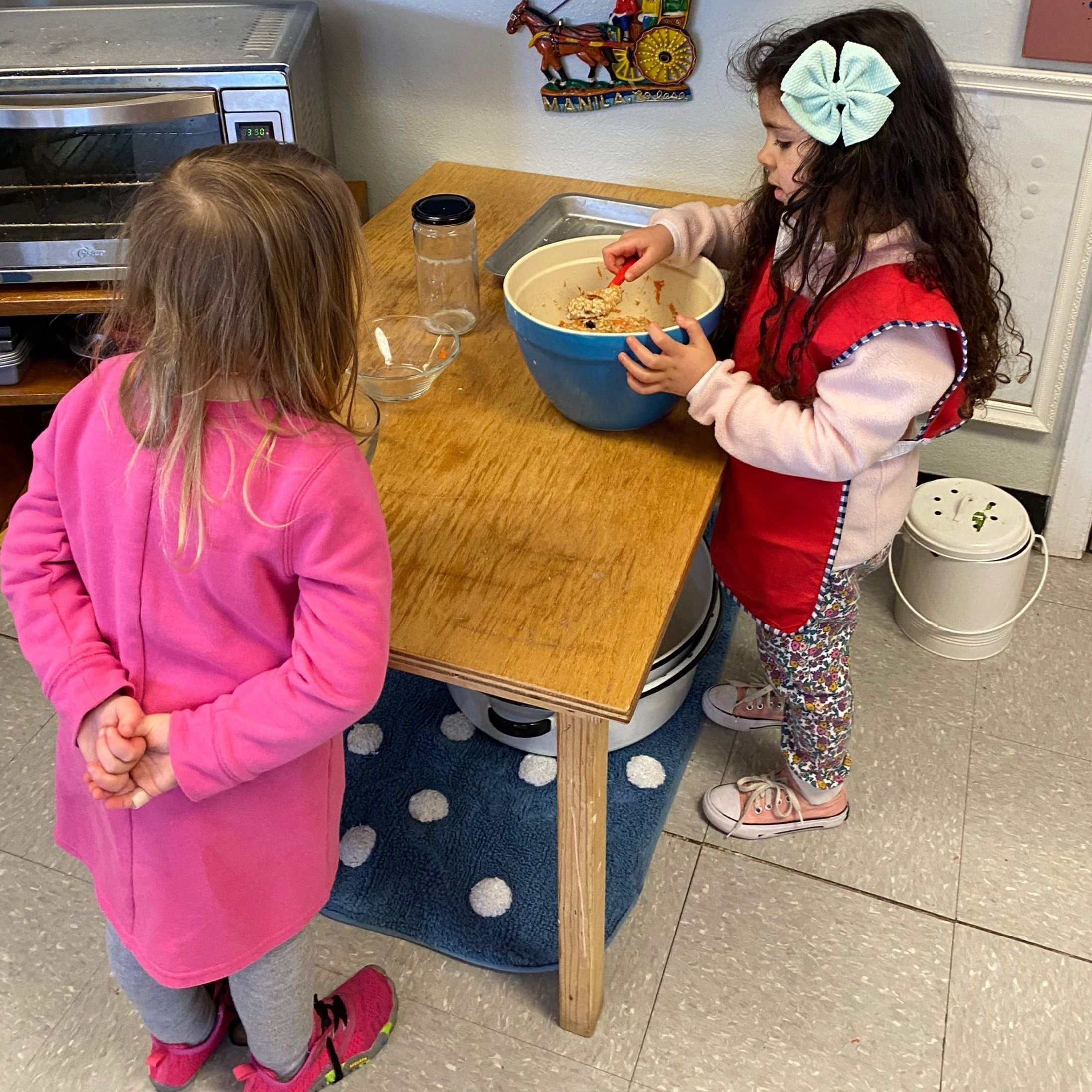
Montessori classrooms rely heavily on the art of observation. You may see it in action some time, or you may have an opportunity to try it yourself (which we welcome and encourage!). If you ever walk past a classroom and see the children working intently, while the guide is quietly sitting in a corner with a clipboard, know that guide is working intently as well.
Why we do it
Dr. Maria Montessori was a scientist and a physician. Her education and background helped her look at the world in a way that is different from most traditional educators. Observation of children was what inspired her work in education, and she used it to develop her methods. Not only that, but Montessori guides all over the world rely on observation to learn about their students, gain insight about developmental phases, inform our decision-making, and to assess the children’s mastery of skills. So what are the main goals of observation in the classroom?
Planning appropriate lessons - Montessori educators are trained to have extensive knowledge about child development. While most traditional teacher education programs require students to take a course on the topic, development is essentially the foundation of everything we do as Montessori guides. Practiced guides know so much about the behaviors of growing children that seemingly insignificant occurrences signal a transition into a new plane of development. The toddler that has mastered toileting and can be observed spending long amounts of time with practical life activities is making the transition necessary for the primary classroom. A child nearing six that has lost a tooth and seems suddenly very motivated by social interactions with their peers is moving into the second plane of development and will respond well to lessons involving storytelling and deeper information about cultures around the world. The challenge of the guide is to identify the moment when a child is entering a sensitive period; this is their development showing they are ready to learn specific skills that must be taught in a way that honors their growth.
Making sure the environment serves the children - While the guide’s role in a child’s education is important, the environment plays an even bigger role. It is the guide’s job to make sure the classroom environment allows children to find what they need, feel inspired to work, fosters independence, and allows for safety and comfort. If, during an observation, it is noted that a piece of furniture disrupts the flow of movement, it will be moved at a later time. If many children prefer to work on the floor, it will be important to note whether there are enough work rugs for them all to use. If no children have used a specific material in a number of weeks, it may need to be reintroduced or removed from the shelf. Each item in the classroom must be placed intentionally and with a specific purpose in mind. If it is no longer serving its intended purpose, reflection and a solution are required.
Assessment of skills - The word assess is derived from the Latin form to sit beside. Montessori schools do not determine mastery with the use of tests, but rather by utilizing observation. Instead of giving children a piece of paper with questions on it, we watch them in action. When a child is able to independently place number tiles in random order on a hundred board, we know they have grasped the concept of ordering those numbers. A child who is able to complete complex patterns within the shape they traced using a metal inset, and who also frequently uses the sandpaper letters correctly is likely ready to learn the written formation of letters using a pencil on a piece of paper. This assessment, of course, ties back into planning appropriate lessons, as the guide has concrete information to inform their instruction.
What it looks like
Formal observations - A Montessori guide will likely observe in the classroom most days, or multiple guides may take turns observing. These observations typically last between fifteen and thirty minutes, but the amount of time can vary. While each guide has their own preferred method, they typically sit quietly and use a notebook to record what they observe. Children are taught about the importance of this work and they know not to disturb the adult at this time. Sometimes a guide will sit in a specific chair or use a special clipboard to signal to the children that they are working. For new guides, the temptation to intervene can be powerful, but we learn that unless a child is in danger it’s often best to wait it out and see what happens. Most classrooms have a second adult that is able to redirect a child who may be overly disruptive, allowing the observing adult to continue. During this time the guide simply watches and takes lots of notes. It is important that the notes be strictly observational and that any judgement or inferencing be reserved for another time.
Informal observations - During the course of the work period, guides will make a great many observations in the moment. While walking across the room to retrieve something, while speaking to a child, or even whilst in the middle of a lesson, there are many helpful bits of information a guide can gather and record that will help make the children’s educational experience the best it can be. As you may imagine, this results in many, many notebooks full of amazing and adorable anecdotes.
Visitor observation
Whether you are considering Montessori for your child, they are in a program but getting ready to move to a new level, or if you’re just curious and want to learn more about the philosophy, observation is one of the greatest tools available to you. Even the most experienced guides make time to visit other Montessori schools when possible so that they may observe other classrooms and gather fresh ideas and inspiration. We invite you to contact us should you be interested in giving it a try.
When you enter a Montessori classroom to observe, it is very important to know that the children will be engaged in their work and the goal is to watch without disturbing them. In many other scenarios in life, we announce ourselves upon entering a room, perhaps even greeting others enthusiastically. When observing in the classroom, we ask that visitors refrain from doing these things, tempting as it may be! You will likely be greeted by an adult or child and directed to a chair. Having a notebook or clipboard is helpful, as you are sure to experience moments you will want to record. If a child approaches you and greets you, by all means please feel free to briefly greet them in return. In general, however, you will need to sit quietly and observe in a way that the children forget you are there, leaving them free to focus on their work. Montessori children are quite used to visitors, so this shouldn’t be a problem.
Some questions that will help guide your observation include:
In what ways are the children displaying independence?
How do the children choose their work?
What do transitions between work look like?
How do the adults respond to the children?
How do the children respond to the adults?
How do the children interact with one another?
How do the children care for their own basic needs?
Does anything about the classroom environment surprise you?
When your observation is complete, it is best to slip out of the classroom quietly. In this situation you are not expected to say any formal goodbyes.
You can do this at home!
While home is very different from the classroom, there are ways that parents can apply the basic concepts of Montessori observation. While trying to engage with our children, it can be easy to fall into patterns in which we begin directing their play. Every once in a while, sit back and watch as your child plays. You may notice them using their toys in surprising ways, and this may give you insight to their interests and maturity. Similarly, it can be tempting to jump in and help any time your child spills something, falls down, or struggles to do something. Instead of rushing to the rescue, wait. If they ask for help, of course, lend a hand, but oftentimes they will want to address the situation themselves. Watching to see what our children are capable of and nurturing their independence is one of the greatest gifts you can give them.
As you pay attention and observe your child’s play, eating habits, sleeping habits, and social habits, you may learn many new things about their development. This, in turn, will allow you to reflect on how you might best support them on their journey through childhood. Slow down, observe, and enjoy those moments.
Material Highlight: The Pink Tower
This week in the Children's House, I wanted to spotlight a favorite iconic Montessori material: the Pink Tower. More than just a block stacking activity this material and body is principles of mathematics and geometry to children as young as two and a half years old. It is usually one of the first presentations offered to a child, but in the last years of the Children's House, the 6-year-olds revisit it again to think about it in a more abstract way.
The Pink Tower, originally designed by Piaget, consists of 10 pink, wooden cubes ranging from 1 cm cubed to 1,000 cm cubed. This progression, together with the properties of length, width, height and weight give the mathematical properties to the Pink Tower. The difference from one cube to the next isolates the difference and allows children to work on visual discrimination of the varying sizes. In the beginning children stack the cubes randomly sometimes smaller cubes in between the larger cubes, which helps them to experience balance and gravity.

Once children stack the cubes sequentially, with the largest on the bottom all the way up to the smallest on the top, they may like to challenge themselves by stacking it blindfolded, or with a sand timer to see how quickly they can do it. There is also exploration with other materials in the classroom like the Brown Stair and the Red Rods. We have also played group games with the Pink Tower, scattering each of the cubes around the classroom and the children must retrieve them and build the tower in order. Another time 10 children each took one of the cubes and hid it behind their back and then each child had to place their cube on the tower in the correct sequence just by feeling it with their hands behind their back. So many fun ways to enjoy!
For older children who are beginning to think abstractly, an association can be made between the Pink Tower and the bead materials for squaring and cubing that is in both the Primary and the Elementary classrooms. It's association is considered indirect preparation for algebra.
All of this supports the development of the mathematical mind in children promoting visual discrimination, grading by size and indirectly preparing children for the decimal system and algebra! Wow!