5 Ways Montessori Appeals to the Senses

Restaurant Blog Graphic (7).png

“The senses, being explorers of the world, open the way to knowledge. Our apparatus for educating the senses offers the child a key to guide his explorations of the world…” The Absorbent Mind p. 167

Learning with all our senses involved allows us to have a fuller, richer experience.  Montessori classrooms strive to provide multi-layered sensory opportunities for children.  The result? Children who have a strong ability to distinguish the variances in the environments around them.

1. Montessori digs deeper than the classic five senses.

Growing up, you undoubtedly learned about sight, hearing, taste, touch, and smell.  Of course, these are the five basic senses we tend to think about, but Montessori education has a more extensively defined list all its own: 

  • Visual - our ability to differentiate objects by form, color, and size

  • Tactile - just another name for the sense of touch, or how something feels on our body

  • Baric - differentiation based on weight and/or pressure

  • Thermic - the ability to sense various temperatures

  • Auditory - another name to describe the sense of sound

  • Olfactory - our sense of smell

  • Gustatory - the sense of taste

  • Stereognostic - a muscular sense, or the ability to distinguish an object without seeing it, hearing it, or smelling it, but relying of touch and muscle memory alone

2. Montessori developed materials to help children refine their senses.
IMG_3828.JPG

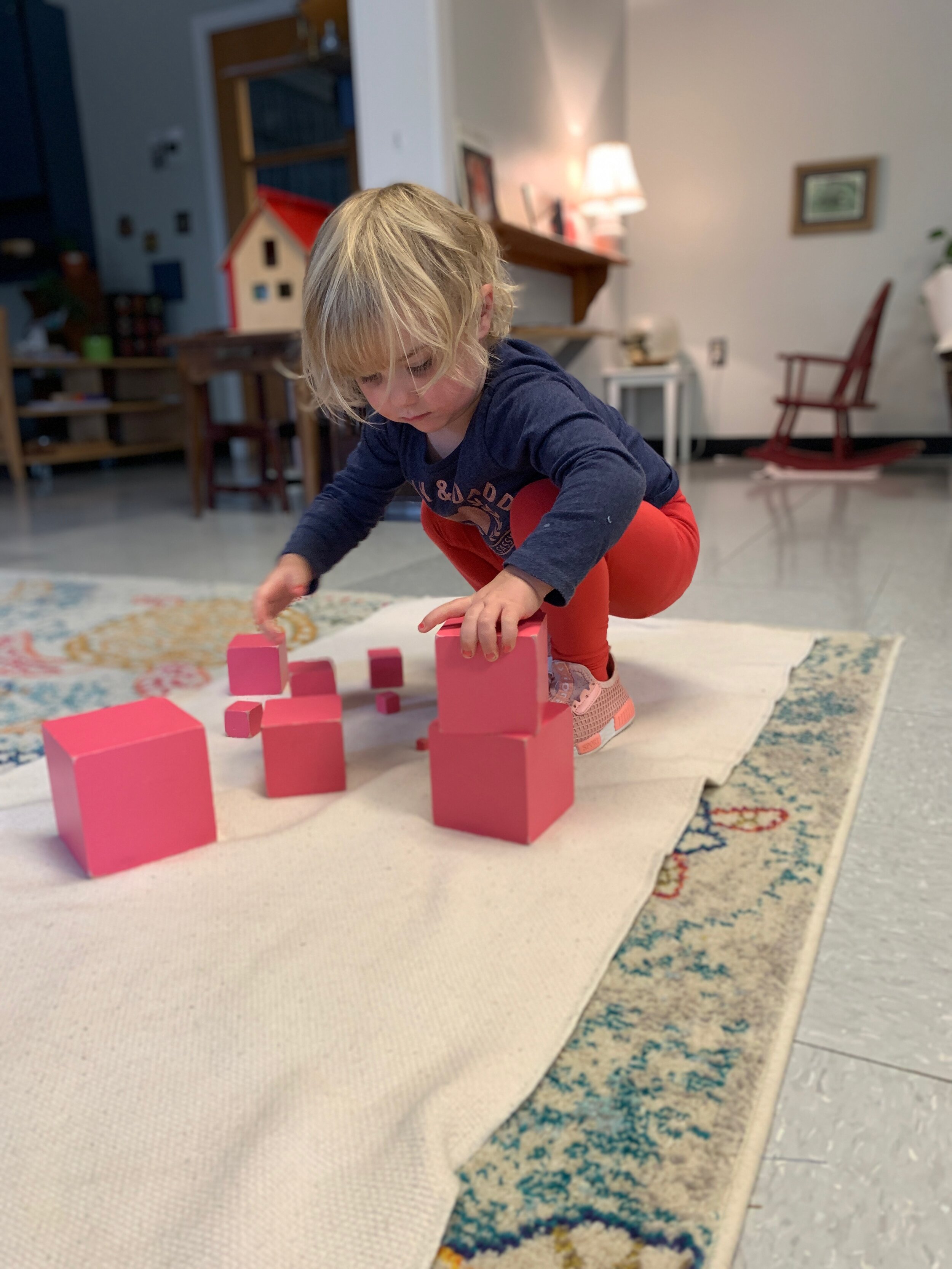
Using what she knew about the above senses, Dr. Montessori developed a series of sensorial materials to be used in the classrooms of young children.  These materials were designed to isolate one skill and to be self-correcting. This allows the child to concentrate their efforts and to be independent in their learning.   Just a small selection of the more famous sensorial materials include: 

  • Knobbed Cylinders - small wooden cylinders with knobs that are to be inserted into holes of the corresponding size

  • Pink Tower - a series of pink wooden cubes ranging in size from 10 cm cubed to 1 cm cubed are meant to be stacked in decreasing succession

  • Brown Stair - ten brown, wooden rectangular prisms in a range of sizes are meant to be arranged in order

  • Color Tablets - a material that allows children to differentiate not just by color, but by shades of colors

  • Mystery Bag - children are meant to reach their hand inside the bag without looking to determine the contents

  • Geometric Solids - a physical representation of an often abstractly-taught concept, these solids allow children to identify their attributes

3. Food is prepared and celebrated regularly in Montessori classrooms.

77b2053febf624176058626671a7e94c91a9c7bd.original - Copy.jpg

Beginning when they are just toddlers, Montessori children are directly involved in the preparation and purposeful enjoyment of food.  Toddler classrooms have regular tastings, in which they try new and interesting foods. Guides will offer a wide variety of textures, colors, smells, and tastes for the children to explore.  These little ones help set the table and learn grace and courtesy through table manners.


9e40163242b16fb72cb69fbc70705d8283e36cef.original.jpg

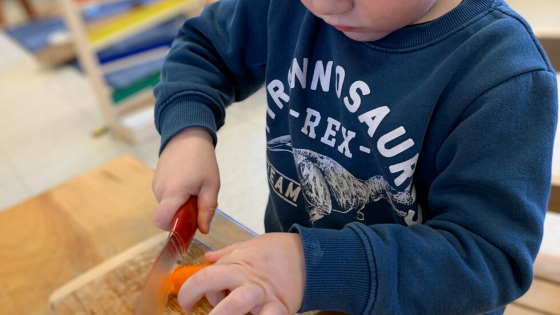
During the primary grades (ages 3-5), children participate in food preparation.  They are given lessons and chances to practice slicing, spreading, mixing, blending, and multi-step food preparation.  Sometimes they enjoy their work as a snack for themselves; other times they prepare food to serve to others.

Guides in older levels find ways to continue this important work.  Food preparation may be connected to a cultural study, birthday celebration, or school lunch program.  As they get older, children are able to complete more complex and interesting recipes. 

4. The classroom environment keeps a focus on the natural world.

Montessori guides are taught to make nature an integral part of the classroom environment, and this often means lots of beautiful indoor plants.  Studies have shown that proximity to plants benefits us a variety of ways. They are visually beautiful, but did you know that scientists believe that houseplants can improve our attention?  They may also be helpful in reducing sick days and keeping us more productive overall. *See links at the end for more information. 

Aside from having live plants in our classrooms, Montessori schools favor natural materials over synthetic.  This means that whenever possible, we choose wood, glass, and natural baskets over plastic. We believe that the color and texture of natural materials is more appealing and calming to our senses.  While many conventional classrooms favor bright colors, we opt for more muted, natural ones. This allows children to feel calm, safe, and able to focus on their work.

Whenever possible, Montessori schools believe in the importance of taking children into nature on a regular basis.  Whether to a local pond, for a walk in the woods, or even a nearby city park, being in green spaces is an important part of learning and growing. 

5. Montessori honors children’s developing vestibular and proprioceptive systems.

A couple quick definitions- 

The vestibular system is responsible for balance and is closely connected to the inner ear. 

The proprioceptive system is important when having awareness of where one’s body parts are in relation to the rest of one’s body and the space/objects around it.

IMG_0122.jpg

These systems typically develop early in childhood.  It’s our job as adults to make sure children have opportunities to refine them.  It is especially important that we provide opportunities to children with sensory related disorders.

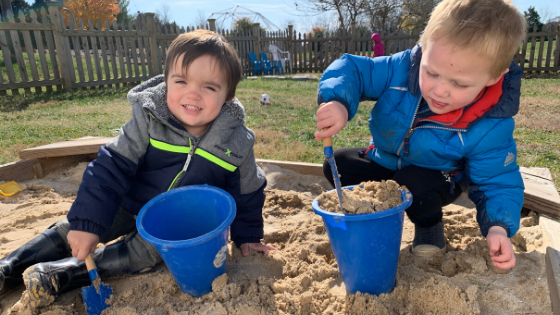
Although many schools around the country are decreasing or doing away with recess altogether, Montessori schools hold that time in high regard.  All the climbing, swinging, spinning, and other types of play are natural ways for children to develop their vestibular and proprioceptive systems.


There are activities built into Montessori classrooms that assist this work as well.  Carrying heavier materials, painting, and using playdough are connected to the proprioceptive system.  The traditional ‘walking the line’ in Montessori primary classrooms provides excellent vestibular input; children must slowly walk while staying on a taped or painted line.  Extensions include walking with a bell in hand and trying not to ring it or balancing something on top of their head.

Interested in seeing the sensory classroom in action?  Whether you are a current or prospective parent, we encourage you to give us a call and set up a time to observe.  

Sources:

Benefits of Indoor Plants…

https://www.sciencedirect.com/science/article/abs/pii/S0272494410001027?via%3Dihub

Psychological Benefits of Indoor Plants…

http://hortsci.ashspublications.org/content/42/3/581.full

Montessori Terminology

Restaurant+Blog+Graphic+%285%29.jpg

Dr. Maria Montessori created her methodology over a century ago, and those of us who study her work and practice her ideas know it really works for children, even all these years later.  Like any specialized approach or body of work, Montessori education incorporates unique terminology. Curious to learn more about what we mean when we say normalized, concrete and abstract, or false fatigue?  Read on to learn more (and bookmark this post for future reference)!


Casa dei Bambini

This was the name of the first school Dr. Montessori opened in Rome, Italy.  It translates to children’s house, and references a Montessori class for 3-6 year olds.  Other names for classes for this age group include casa, primary, children’s house, or early childhood.  Casa classes are a combination of preschool and kindergarten.

concrete & abstract

Dr. Montessori believed that “the hand is the instrument of the mind.”  She understood that children learn best by doing first and internalizing later.  In Montessori classrooms, we give children specialized learning materials that they manipulate with their hands to begin grasping various concepts.  Over time, they use materials that are less concrete, and require more abstract thinking, until they are eventually able to master a skill without the use of any material at all.   

control of error

One hallmark of a Montessori education is supporting children to become independent learners.  Most of the materials children use in our classrooms incorporate a control of error; that is there is only one way to correctly use the material.  If a child uses a material incorrectly, they will not be able to complete the activity, and will understand they have made a mistake somewhere along the way.  An opportunity is provided naturally: instead of a teacher correcting a child and telling them what to do differently, the child is able to self-assess and determine what changes they need to make on their own.

cosmic education

During the elementary years, children begin seeking out answers about the universe and their place in it.  It is our job to provide children with lessons and experiences at this age that aim to satisfy their curiosity, and to give them a deeper understand of the interconnectedness of all things.  We call this broad study cosmic education.  Elementary classrooms use special impressionistic lessons to inspire children as they explore concepts such as the creation of our universe, the evolution of life on earth, the evolution of humans, and the origins of math and language.

Erdkinder 

This was the name Dr. Montessori gave to her ideas about education for adolescents.  The German word for Earth-Children, she felt we should focus less on testing and college preparation and more on self-sufficiency.  Erdkinder programs are traditionally run as farms that serve as micro-economies, with the students running and managing all aspects of operations.  Today, some Erdkinder programs interpret the ideas differently, with students running a variety of small businesses themselves. Traditional learning is also an element of the program, and real-life experiences are often closely connected to any classroom experiences.

false fatigue

In Montessori classrooms we set aside a large chunk of time (3 hours for children 3 years of age and older) each day in which they receive lessons and work independently.  (Learn more about this in the definition of work period below.)  At a certain point during the course of this time, an adult observing will begin to notice the volume in the classroom beginning to rise, social activity beginning to increase, and an apparent decrease in productivity.  Our task is to pause, wait, and watch for the flow of the room to return naturally to its previous state. We all need a break once in a while, and it is normal to expect that children will, at some point, need to step away from the work they have been deeply engrossed in.  In the long run, this false fatigue break actually allows them to be more productive and focus better once they return to their work.

grace & courtesy 

This phrase is applied to the approach Montessori schools have when teaching children how to interact with others.  Manners play a part of this work; we explicitly teach children how to say please, thank you, excuse me, and you’re welcome, but it’s also so much more.  We teach children how to navigate friendships, how to resolve conflict, how to express gratitude, and how to share their own feelings.    

guide 

While the term teacher is sometimes used, many Montessori schools opt for the term guide.  Our educators do not stand in the front of the classroom and impart their knowledge upon students in conventional ways.  We don’t feel that our task is to give them information, but rather to lead them toward it so they may discover it themselves.  The term guide is much more fitting.  Another traditional term that is sometimes used in our schools is directress.    

Nido

Nest in Italian, this is the term Montessori uses for the infant program.  Nido classrooms are nurturing and secure, giving babies a safe and comfortable place to begin their exploration of the world.

normalized 

When Dr. Montessori began using this word to describe children a century ago, it was used with a very positive connotation.  When a child is normalized, it means they have embraced to ability to learn independently within the Montessori classroom; they are able to enter the environment confidently, select work that interests them, and complete it with concentration and perseverance.  That is not to say they never feel struggle or frustration, they have simply internalized the expectations of the environment and are joyful learners in the community.

planes of development

As a scientist, Dr. Montessori carefully studied patterns in children’s learning.  Her observations led her to notice specific planes, or stages, of development. Each plane is marked by very specific differences in the way children view the world and learn from it.  Having this information assists educators in creating environments and utilizing approaches that teach the child according to how they are developmentally prepared to learn. The first plane includes children ages 0-6, the second plan 6-12, the third 12-18, and the fourth 18-24.

practical life

We make it a point to teach children a range of skills they will need to be successful.  While math, language, and science certainly make the cut, there’s a lot more to life than traditional academic subjects.  Practical life exercises teach children how to clean up after themselves, how to feed themselves, or how to do any number of tasks that are required of us as we grow to become independent humans.  We do not give children pretend food to cook with or play tools; we give them beautiful, sturdy, child-sized versions of the real thing. This allows them to take this practice seriously, and to know that we take them seriously, too.

prepared environment

This is typically what we use to refer to our classrooms, but the term could actually be applied to just about anywhere.  When a Montessori adult takes special care in creating a space that serves the child in their developmental stage and allows them to explore and learn independently, they have prepared the environment.

sensitive period

During her years of observation, Dr. Montessori noticed that children went through typical periods in which they seemed primed and ready to learn specific things.  While there is of course some variability, Montessori guides know when to expect children to be ready to learn early math skills, beginning language work, gross motor skills, and so much more.  If we introduce a skill too early a child is likely to become overwhelmed and frustrated, if we miss the window, or sensitive period, the child is likely to have lost interest to an extent.

sensorial 

Montessori toddler and primary classrooms provide children with a series of lessons and materials that allow them to refine their various senses.  These are referred to as sensorial materials, and help children learn differences in weight, size, color, shape, scent, sound, and more.

three-period lesson

The three-period lesson is one way Montessori guides present information and assess comprehension.  The first time information is presented to the child, the guide names it. For example, “This is the gill of a fish.”  The second time (perhaps the same day, perhaps not), the guide will point to a picture and ask the child, “Where is the gill?”  The third, and final period consists of the guide asking, “What is this?” when they point to the gill. This strategy may be used for presenting and assessing a wide range of skills.

work 

Any time a child is focused on a learning activity we refer to this as work.  This does not mean the child must be writing something down on a piece of paper, in fact more often they are not.  We recognize that work looks different at different ages, and we honor its importance regardless.  

work period/cycle

Montessori schools utilize a three-hour period of time each morning in which children are able to dive deeply into their work.  We recognize that it can take some time to settle into the flow of the day, and giving children this gift of time allows them to fall into stronger patterns of learning and independence.  Older children often have a second work period/cycle during the afternoon.

Chores: They’re Good for Your Kids!

Restaurant Blog Graphic (3).png

Chores: the word has such a negative connotation.  But does it need to be that way?

Do you remember doing chores when you were growing up?  For some of us, we remember them as a negative consequence.  For others, we never had them and it took us a while to learn how to do them as adults.  Still others remember helping out around the house but not thinking it was a big deal. It’s all in how we, as parents, frame it for children. How we present the concepts of chores makes all the difference.  Having kids pitch in isn’t just helpful for us (because, let’s face it, it’s often more work for us on the front end), it’s really good for them, too!

What are the benefits?

There are so many important reasons to incorporate regular chores into your children’s routines at home.  Here are just a few:

  • Developing independence

As Montessorians, we see great value in teaching kids to do things for themselves.  It feels incredibly empowering to master a task and be able to complete it by oneself.  Young children are at the perfect age to begin this work, as they are constantly looking for ways to do things independently.  

  • Fostering a sense of belonging

By giving children ways to contribute to maintaining the home environment, you are effectively letting them know they are a valued, important member of the family.  Besides, working side by side to tidy up is bonus time spent together, and couldn’t we all use a little more of that?

  • Learning practical life skills

We all need to learn how to do our laundry, wash our dishes, and pick up after ourselves.  Just like children need guidance when learning how to read or add, they need the same with basic life skills.  When we get down to their level and show them how to do the job, we are setting them up for a future of success as adults.

Options for all ages!

Well, we can let the infants take a pass here.  Even young toddlers, however, are perfectly capable of learning some basic chores.  The following is a collection of suggestions. It would likely be far too much to implement all at once, or even for one child to be wholly responsible for an entire list.  Think of it as potential inspiration, or guidelines to help you determine what your child is developmentally capable of.  

a1cba51001e9751f8b1249f3d2fec1fb99bf5098.original.jpg

Toddlers (yes, toddlers!)

Even little ones have a lot to offer around the house.  Start small and offer child-sized tools.

  • On the floor beside where your child eats, use painter’s tape to create a small square.  Using a small dustpan and brush, show your child how to sweep the crumbs into the square, then into the dustpan.  It can be fun to keep the dustpan available on a nearby hook, beside a small container of colorful pom poms or the like.  Your toddler will love practicing!

  • Teach your child how to fold napkins.  Keep a small basket with napkins in it available for them to practice.

  • Let them help set the table.  Watch their tiny face light up at being given such an important task.  Resist the urge to straighten things out when they’re done!

  • Teach them to put their own toys away and be consistent about having them clean up as soon as they are finished playing.  They may need some help, but they are capable of putting toys back into a bin or on a shelf.  

Preschoolers

This is a great age for children to learn chores. They are able to do more than we often think they can, and they are so excited to help! 

  • Clear the table.  They will probably need to make multiple trips to avoid breaking dishes, but they will delight in collecting plates and cutlery to bring to the kitchen.

  • Teach them to wash the table.  First, show them how to carefully brush crumbs off into their hands (you can also buy a special crumb set here if it’s easier: https://www.forsmallhands.com/small-crumb-set ).  Next, show them how to wash the table with whatever method you prefer.  It can help to have a small bucket of soapy water with a sponge and dry cloth.  They will need lots of modeling (remember to emphasize wringing out that sponge!).

  • All that sweeping practice they had when they are toddlers?  It can continue now, and they can also learn to mop. Remember that child sized tools make it easier for them to get the job done.

  • Kids this age can feed pets, although they may need you nearby.

  • Give preschoolers the task of choosing and laying out their own clothing.  In the beginning they will need guidance as to what is weather-appropriate.  Be prepared for some outfits you will perceive as wacky but take that moment to appreciate their blossoming independence and sense of personal style.

  • Show them how to care for plants.  Chances are, they’re already doing this in their classrooms at school to some extent.  Teach them how to water and talk about how we know when plants need water.


Young children

As the child gets older they are capable of so much more.  Children ages 5 through about 8 are very competent, though they may be a bit less enthusiastic than they once were.  Building chores into the family routine will make this easier for everyone.

  • Children at this age can fold and put away laundry.  Start small: a full load of laundry to put away by themselves the first time will only set them up for frustration.  Sit together and teach them how to fold various items. Sort through clothes and let them choose a category the first few times.  For example, they may fold all the shirts while you work on the rest. Slowly increase their responsibilities as they gain the skills necessary to complete the task.

  • Kids who are eating lunch at school can help pack it themselves.  Teach them how to make a sandwich, chop vegetables, and even how to select a balanced variety of foods.  Remember that choice and independence are very empowering.

  • Let them empty the dishwasher.  If they can’t reach a particular shelf, keep a step stool nearby.

  • Chores that are tedious for adults, like dusting or washing the baseboards, are great fun for kids.  If it gives them the sense that you trust them with an ‘adult’ task, they will likely be thrilled to give new tasks a try.

  • Depending on their size, let them vacuum rugs.  


Older children

Again, as certain children get older you may be met with initial resistance whenever introducing a new chore.  Try to keep it light and fun, and present it as a positive: as we get older we may have more responsibilities, but we gain new freedom and privileges.

  • Weeding the garden is a great task for older children, but they’ll likely enjoy it more if you’re weeding alongside them.

  • They are now old enough to do the laundry.  Start small and set the expectation that they do their own laundry.  They will need reminders, but having a system (a basket of their own and perhaps a sticky note with how-to reminders) will help get the job done.

  • Again, depending upon the child’s size, they are likely able to take out the trash and recyclables.  

  • You may consider increasing their responsibilities in regards to pet care.  They may be able to walk the dog, clean dirty cages, and do some basic grooming.

  • If they haven’t already learned, now is a great time to teach them how to make their own bed.  This includes learning how to change the sheets.

  • If your child has been attending a Montessori school, they’ve been learning how to prepare their own food since they were 3 years old.  Take advantage of that knowledge base and let them make lunch for the family once in a while. They may even want to try more cooking or baking on their own (but with supervision).


Teenagers

f917905948a4c076eeff707486e7d5708b9d220b.original.jpeg

Teenagers are able to do most, if not all, of the chores we do as adults.  Remember, we are not suggesting they do all of these chores all the time, but reinforcing the idea that they are capable of any of them will help set them up for success.  Sitting down together and agreeing on a schedule or rotation might be a good starting point. Here are just a few ideas:

  • Let them mow the lawn or rake the leaves.

  • Have them wash the dishes.

  • Give them a chance to watch younger siblings while you run errands or go to an appointment.

  • Teenagers can do some more thorough cleaning, like wiping down counters or washing the bathroom.

  • Let them cook dinner.  Instead of viewing this as a chore, they may enjoy the opportunity to choose the recipe and help shop for the ingredients themselves.


When giving a child of any age chores to do, the key is to find balance.  Chores are so important for their development, but so are things like play, reading, time together as a family, and time with friends.  Be aware that children can often do more than we think they can, but also be aware of the big picture that is their life.  

Looking for more ways to cultivate independence?  Montessori may be the answer. Call us today to learn more.