Primary

Letting Your Child Engage in the Struggle

By Jen Ashton, Primary Directress

Restaurant Blog Graphic (23).png

“The child’s conquest of independence begins with his first introduction to life. While he is developing, he perfects himself and overcomes every obstacle that he finds in his path. A vital force is active within him, and this guides his efforts towards their goal.”

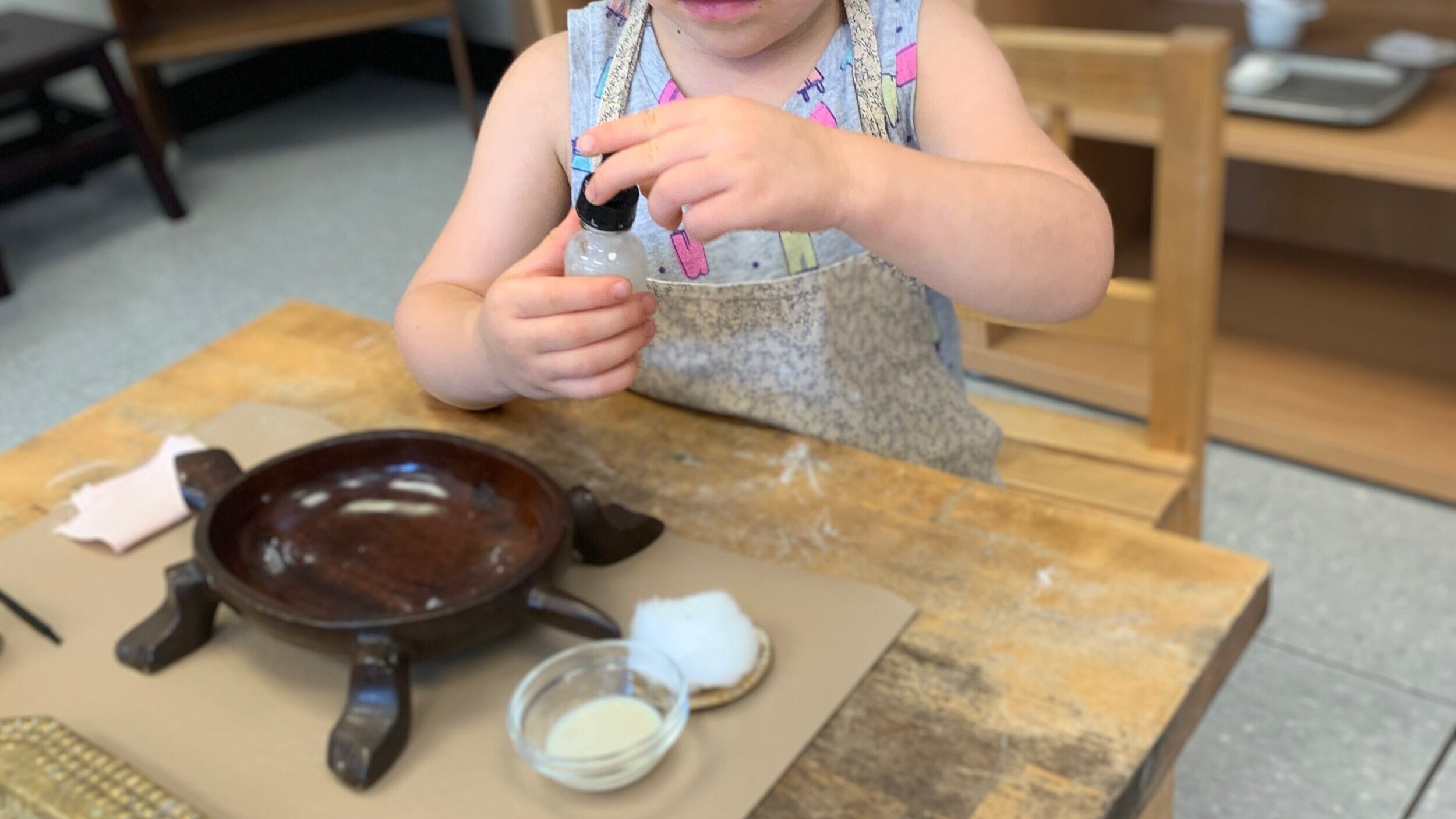
In the Children’s House, a child figuring something out for themselves is where they experience success and growth! The activities of daily life are more about process then the end product. A child polishes a tray because they love the process of setting everything out on a table, choosing a beautiful object in the classroom, applying polish to it and rubbing it off. The next day they choose the same object and polish it again. Perhaps the first time the child struggled with the polish dropper, but we show again how (or maybe another child helps) and then step back to allow practice, so the third time or fourth time is successful in squeezing it out. The joy in a child’s proclamation, “I did it!” is often heard in the Children’s House, from one whose struggle has been long and determined. As the adults in the classroom, if we interrupt it, we not only hinder a child's development in the area of independence but we rob them of the joy experienced with the moment of successful accomplishment!

As adults it is hard for us to stand by and not offer to do something for the children that is struggling with something. However, we understand that it is important for children to take the time that they need to do things for themselves. This is not to say we abandon a child to struggle alone. We are there, offering a quiet presence, watching and observing, and occasionally (just before the tipping point of mad frustration) offering a little point of interest with the words, “let me show you the next step and then you try.” The more time we spend with children and watch their growth and successes, the more we are able to internalize the importance of children being able to do things for themselves.

File_000 (13).jpeg

This is why we wear tie shoes in the classroom. Tie shoes offer the older children, who know how to tie, an opportunity to offer their shoe tying services to others who don't know how to do it. Some of the younger children are aspiring to be like the older who already know how to tie, and it gives them a sense of determination: twisting and looping and lacing and twirling over and over again. This week I heard from one of the younger children, the beautiful shoe tying proclamation, “I made the first tie!” A few other children in the classroom who were nearby came over to enjoy their success. Then the child said, “Next, the loops!” I took so much enjoyment from this moment, and not just for the child who made the tie, but more from watching the other children who also gathered to enjoy this moment when someone succeeded in their struggle.

Another child was struggling to UNTIE his double knotted shoes. He kept pulling the loops tighter and tighter. Several times, I have shown how to find the place where the laces cross over and gently tug them apart until they were loose. Occasionally the shoes would be slipped off his feet with the loops still in place and he would bang the shoes on the floor... This week I looked over at him sitting on the floor, smiling a huge smile with both shoes in front of him.. untied, laces tucked in and super proud of his accomplishment! Maybe the other children didn’t notice this time, but he knew it and I knew it and we both enjoyed the success together!

Montessori Basics: Reality vs. Fantasy

Restaurant Blog Graphic (16).png

We all know Montessori classrooms differ vastly from their more conventional, traditional counterparts, and views on how children developmentally react to fantasy and reality are one of the key components of those differences.

You may or may not already know, but Montessori schools discourage the introduction of fantasy to young children (children under the ages of 5 or 6). This means we do not use play kitchens, have a dress-up area in the classroom, or rely on books with dragons and fairies. This often evokes a visceral reaction from those new to the approach, but after learning the scientific reasoning it makes much more sense.

Some people hold a misconception about Montessori regarding their assumption that the method stifles imagination and creativity. The is unequivocally false. We wonder if this misconception stems from tangled definitions of fantasy and imagination, which are two very separate concepts. Fantasy is the stories and ideas drawn from a world which does not exist (those fairies, dragons, talking horses, etc.). Imagination is the ability to conjure images or scenarios in one’s own mind, separate from present sensorial input.

So, what is the difference, really?

IMG_3791.jpg

Fantasy is giving wooden fruit to play with instead of a real banana to slice. Fantasy is reading a book about a talking dog rather than reading a book about the different breeds of dogs around the world.

Imagination is a child on the playground pretending they are an eagle because they saw a live one for the first time that weekend. Imagination is children playing ‘family’ because they are driven to practice the roles that are modeled for them in their own homes.

Imagination is inherent in the human mind. It’s where our creativity comes from, and it’s one of the ways we process learning about the amazing world around us.  As Montessorians, we revel in the magic of imagination (and, as children get a bit older, we use it to our advantage, but more on that later).

As Montessorians, we recognize that young children have a difficult time distinguishing the differences between reality and fantasy, and that blending the two within their experience can be confusing.  We also know, from Dr. Montessori’s own observations, that young children typically prefer reality to fantasy.  For example, in her first classroom, she had a dollhouse and read folktales.  Children were far more interested in leaving those activities behind to observe an earthworm or serve tea to visitors.

Our perspective asserts that in a young child’s life, everything they encounter is awe-inspiring and fills them with wonder.  We need not tell them tales of unicorns, in part because they often have a hard time distinguishing between whether they are real or not, but also because an actual horse is just as fantastic to them.  When the whole world is still relatively brand-new, animals, plants, the environment, and real people provide more than enough inspiration for their young minds.

File_000 (5).jpeg

We all know that even very young children utilize their imaginations (as we mentioned several examples above).  This is a normal and natural part of development which we value and honor.  We would just rather give our students real, authentic opportunities as opposed to presenting them with fake ones.  We know that a three-year-old is fully capable of learning basic food preparation skills, so we guide them and leave them with a sense of empowerment.  Even a toddler is old enough to begin learning how to sweep up a mess on the floor.  Rather than supplying a toy cleaning set, we make available real cleaning tools that are appropriately sized, and we guide young children as they learn to use them effectively.

Once children enter the second plane of development, around age 6, our approach shifts.  We know children are more able to differentiate between reality and fantasy, so we don’t discourage fantasy books (although we do provide plenty of nonfiction).  We also know that children at this age, through about age 12, are highly motivated to learn through the use of their imaginations.  

While we still do not rely on fantasy to drive our teaching, we do lean heavily on imagination for older children.  Several of our most important, foundational lessons about the universe, life on Earth, and humanity itself are delivered with the use of storytelling.  The stories we tell are true, but we allow children to mentally picture themselves in historically critical moments.  Elementary-aged children are seeking to find their own place in the universe, and their developed sense of imagination helps take them there.

So, what are the practical implications of these principles in regards to parenting? We would say give your young children the gift of reality! Give them opportunities to use real tools, to go outside and observe and discuss real things. The younger the child is, the closer to reality everything that you present to them should be.

What a Wooden Table Brings to the Table: The Benefits of Natural Materials in the Classroom

Restaurant Blog Graphic (12).png

“The senses, being explorers of the world, open the way to knowledge.” -Dr. Maria Montessori

Upon entering an authentic Montessori environment, one of the first things you will notice is the materials. It is unlikely that you will encounter any cartoonish alphabet posters, any star charts, any brightly colored plastic cubbies or any plastic tables. What you will find is a variety of wooden, glass, and metal materials, sturdy child-sized furniture, house plants, and walls decorated with prints of classical artwork from cultures around the world. Maria Montessori insisted that an environment as closely rooted in nature and reality as possible was the most beneficial to the individual child. Here are some of the reasons why!

1. Naturally Sourced Materials Promote Sensorial Exploration

IMG_3738.jpg

Dr. Montessori emphasized the use of real materials in the classroom. Materials such as brass, wood, wicker, cotton, metal, and glass provide important information to the child. Some warm to the touch and cool with the air. Others are rough and dense. Some are heavy and some are light. Some are durable and some are fragile. These provide a multi-sensorial experience for the child.

2. The Natural World Is Important for Development

By utilizing materials that come from nature in your child’s belongings, it puts them closer in touch to the real world around them. By doing this, you are encouraging a connection to the earth and the environment. 

3. Natural Materials Last

Plastics fade in color, and their quality is not normally the best. Natural toys made from wood or metal pass the test of time. They are durable, classic, and enduring. Many materials go years in the classroom before needing to be replaced. The child can work with the material with no fear of damage. 

4. Natural is Better for the Environment

Taking care of the environment is at the core of Montessori philosophy. It’s a positive that our materials don’t sit in landfills for years on end. Instead they can be recycled, re-purposed, or they will biodegrade. 

5. Natural Materials Are Beautiful

IMG_3783.JPG

The prepared environment is an important concept of Montessori learning. Natural materials are beautiful and real, thus making them more attractive and appealing to the child. 

6. They Inspire

Simple and natural materials create opportunities for open-ended work. This allows children to make their own discoveries, test hypotheses, and develop new skills, particularly when the child plays independently.

Overall, what parents want for their children is for them to feel comfortable, safe and happy, whether they are at home or at school. A Montessori environment is meant to mimic and be an extension of the home. Every detail is designed to ensure that it is a place where the child can feel truly at home and at ease. Our children deserve the best that we can give them, and the best that we can give them is reality and beauty.